Workforce Optics
Insights, numbers & knowledge
for a competitive workforce
NOVEMBER 2026 ISSUE
Welcome! October job growth rebounded, hiring activity is picking up across industries, and seasonal demand is offering fresh signs of employer confidence. But beneath the improving numbers, workers are still struggling with job security, rising costs and longer job searches. This month, Workforce Optics explores whether the labor market recovery has staying power, from shifting wage dynamics and manufacturing’s continued growth to the workplace communication challenges testing employee engagement.
Jobs Update
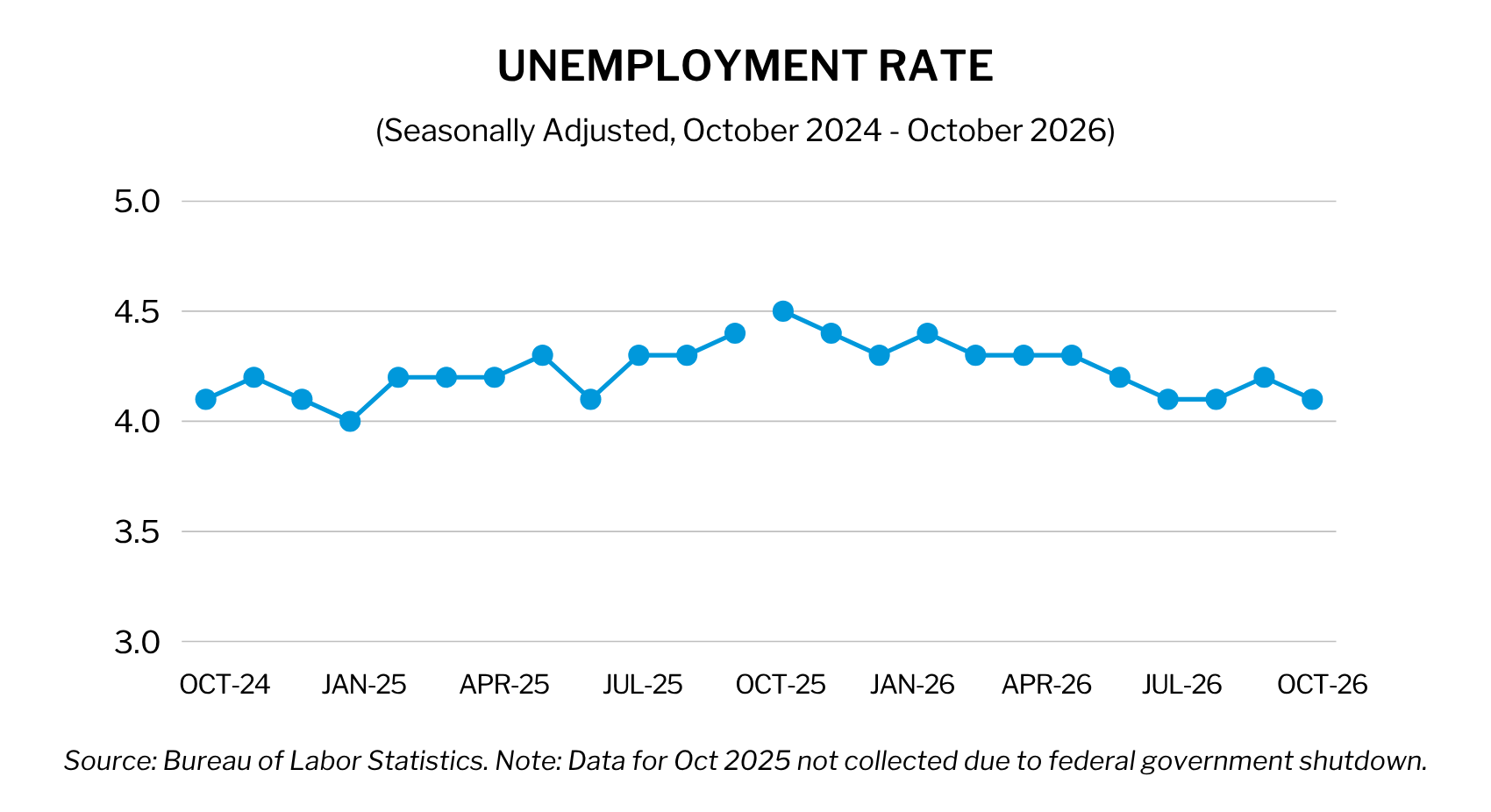
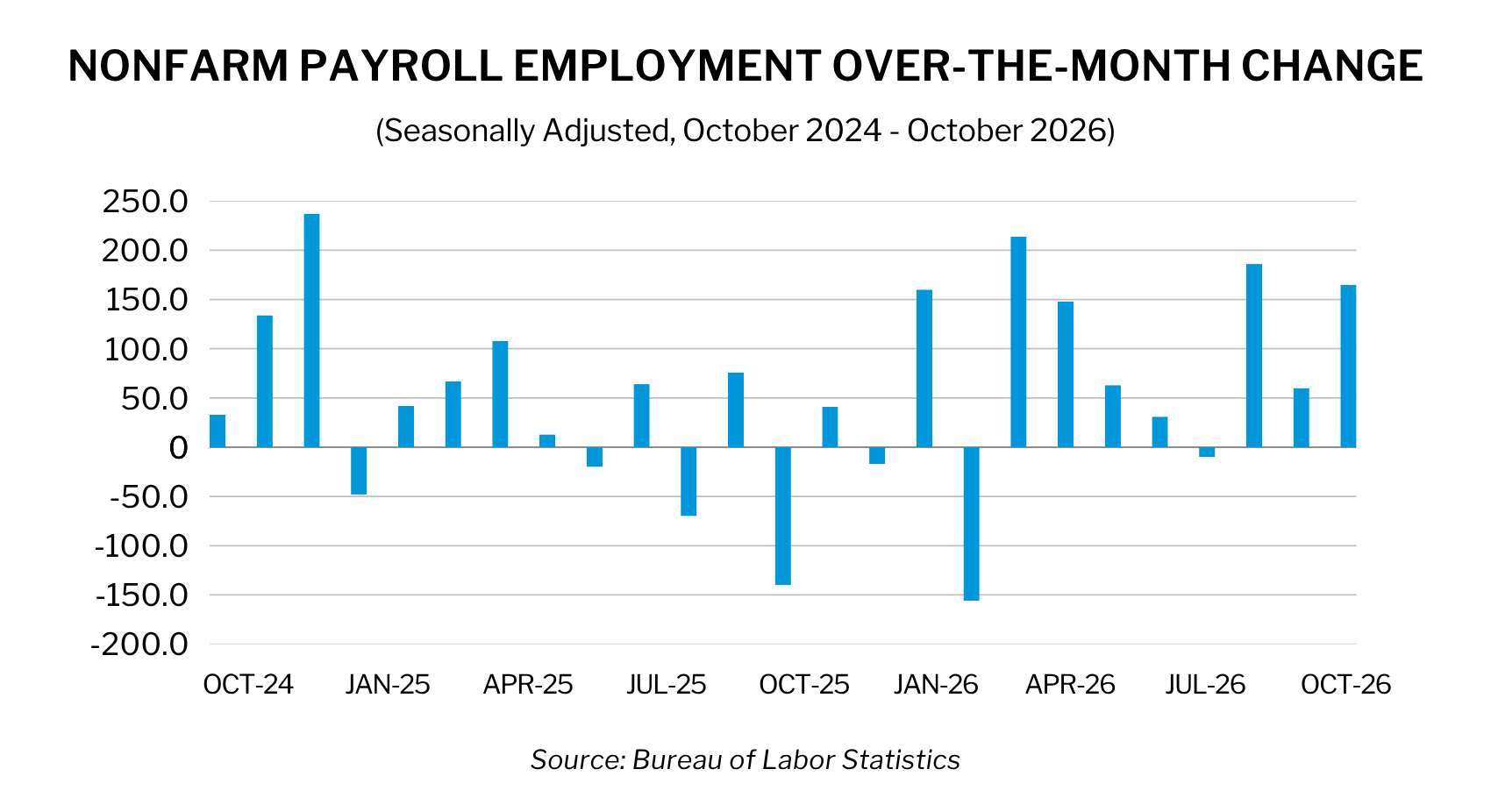
U.S. hiring rebounded sharply in October, offering an encouraging sign that the labor market may be regaining momentum after months of sluggish growth. According to the latest Bureau of Labor Statistics (BLS) Employment Situation report, employers added 165,000 jobs in October, significantly exceeding the average monthly gain of 48,000 over the previous 12 months.
The unemployment rate edged down to 4.1% from 4.2% in September, with approximately 7.1 million Americans unemployed. Job growth was concentrated in professional and business services (+70,000), healthcare (+42,000), and transportation and warehousing (+25,000). Manufacturing also added 19,000 jobs, while employment in construction, retail, leisure and hospitality, and government showed little change.
Revisions to previous months further strengthened the employment picture. August’s job gains were revised upward from 133,000 to 186,000, while September’s gains increased from 29,000 to 60,000, adding a combined 84,000 jobs to previous estimates. Labor force participation edged up to 61.9%, while average hourly earnings increased 0.4% in October and 3.1% over the past year.
However, wage growth continues to trail inflation, putting additional pressure on workers’ purchasing power. The number of people working part time for economic reasons also increased by 339,000 to 4.8 million, suggesting that some workers are still struggling to secure the hours or employment opportunities they need.
Source: Bureau of Labor Statistics October Employment Situation Report
Holiday Hiring Heats Up, but the Labor Market Remains Frozen.
The labor market is showing tentative signs of improvement, but workers are still feeling the strain of sluggish hiring and rising living costs. In this month’s Workforce Optics interview, Glassdoor economist Daniel Zhao noted that the wage premium for switching jobs has begun widening again in recent data from ASA, potentially signaling a modest improvement in labor market conditions. However, with job openings trending at levels last consistently seen in 2019 and hiring trending at levels last consistently seen in 2017, few workers are able to successfully secure new positions.
Indeed economist Laura Ullrich pointed to stronger demand for senior-level talent, with both job postings and advertised wages accelerating for more experienced workers. Meanwhile, employee satisfaction with compensation and benefits has declined since 2022, although Zhao says workers appear even more concerned about job security, layoffs and feeling stuck in their careers than about wages alone.
One potential bright spot is seasonal hiring. Indeed reports that seasonal job postings are up approximately 10%, suggesting retailers and delivery companies remain optimistic about holiday spending. Some major retailers are also shifting from temporary seasonal positions toward permanent part-time roles, potentially signaling greater confidence in staffing needs beyond the holidays.
But workers are showing even stronger interest in seasonal opportunities, with job searches rising roughly three times as fast as postings. Ullrich suggests affordability pressures may be contributing to that demand, noting that 16% of job seekers in Indeed’s recent research reported holding two or more jobs.
Warehouse, fulfillment and logistics roles remain important to seasonal hiring, while competition for overlapping skills from data-center development could add pressure to certain labor markets. Zhao says one of the most revealing indicators will come after the holidays – how many seasonal positions convert into ongoing part-time or full-time jobs.
Beneath these encouraging signals, however, a more persistent labor market challenge is emerging. Zhao explains that the prolonged “low-hire, low-fire” environment is making it increasingly difficult for unemployed workers, recent graduates and people returning to the workforce to find jobs. Looking toward 2027, Ullrich cautions that AI and other technological changes could create more structural labor market disruption, with new, higher-paying opportunities emerging for experienced workers while entry-level and administrative positions face greater uncertainty.
About the experts

Laura Ullrich is Director of Economic Research in North America at the Indeed Hiring Lab. Her research interests include higher education, community college policy, labor participation, and the economic impact of local development.

Daniel Zhao is the Chief Economist at Glassdoor, where he oversees labor market research and workplace analytics. He specializes in employee sentiment, job search behavior, and economic forces shaping the modern workplace.
employment news of note
The Era of No Reply
Workplace communication is becoming a growing productivity challenge as employees struggle to keep up with an overwhelming volume of messages. According to research cited by Korn Ferry, one-third of corporate emails go unopened, while 40% of internal emails receive just one to three seconds of attention. In addition, Gen Z workers are 82% more likely than Gen X workers to avoid emails requiring action, suggesting that traditional communication practices may be increasingly out of step with employee preferences.
For employers, the solution may be less about sending more messages and more about communicating with greater clarity and intention. Establishing expectations for response times, identifying the appropriate channels for different types of communication, and making messages shorter and more actionable could help organizations reduce friction, improve collaboration and reclaim lost productivity.
Source: Korn Ferry, October 28, 2026


Hiring Shows Signs of Life After a Prolonged Slowdown
U.S. hiring showed signs of improvement in September, according to LinkedIn’s October Workforce Report, with hiring activity rising 3.2% month over month and 5.1% over the previous two months. Hiring increased across 15 of the 20 industries tracked, led by education (+8.5%), retail (+6.7%) and administrative and support services (+3.4%). However, hiring remained 3.4% below September 2025 and 22.6% below February 2020 levels, underscoring how far the labor market remains from a sustained recovery.
The report also reveals important differences across industries. Manufacturing hiring increased 2.0% year over year, while administrative and support services rose 1.4%. In contrast, real estate and equipment rental services experienced a 13.0% annual decline. For employers, the findings suggest hiring momentum may be improving, but the recovery remains uneven and highly dependent on industry and location.
Source: LinkedIn October 2026 Workforce Report, October 27, 2026
AI's First Workforce Disruption May Be Wages, Not Jobs
Economists are becoming cautiously more optimistic about hiring but increasingly concerned about AI’s potential impact on wages, particularly for college-educated workers. In Indeed Hiring Lab’s latest quarterly survey of more than 120 economists and academics, respondents projected a modest 0.13% increase in job openings during the fourth quarter, reversing earlier expectations of continued declines.
However, the survey also found growing concern that AI could displace college-educated workers and put downward pressure on their inflation-adjusted wages over the next 12 months. Expectations for non-college-educated workers remained comparatively neutral, suggesting AI’s near-term economic effects may be concentrated among workers traditionally considered less vulnerable to automation.
Source: Indeed Hiring Lab, September 24, 2026

Manufacturing Update
Factory Floors Are Getting Busier
U.S. manufacturing gained momentum in October, with the ISM Manufacturing PMI rising to 55.5%, up from 54.5% in September, marking the sector’s tenth consecutive month of expansion. Production strengthened significantly, with the Production Index climbing 2.3 percentage points to 59.0%, its highest reading since November 2021.
New orders also improved slightly to 55.5%, while manufacturing employment remained in expansion territory at 52.4%, despite edging down from September. Twelve manufacturing industries reported overall growth during the month, signaling continued demand and production activity across much of the sector.
However, rising costs and supply-chain pressures remain significant challenges. ISM’s Prices Index declined from 77.9% to 75.2%, indicating that input prices continued rising, although at a slower pace. Supplier deliveries also slowed further, while order backlogs remained elevated. Taken together, the report points to a manufacturing sector with strengthening production and demand, but one still navigating persistent inflationary pressures, supply-chain constraints and uncertainty about future costs.
Sources: Manufacturing ISM® Report On Business® & Institute of Supply Management, October 2026
| ISM’S EMPLOYMENT INDEX | |||||
|---|---|---|---|---|---|
| EMPLOYMENT | %HIGHER | %SAME | %LOWER | NET | INDEX |
| October 2026 | 14.4 | 74.8 | 10.8 | +3.6 | 52.4 |
| September 2026 | 15.3 | 70.2 | 14.5 | +0.8 | 52.7 |
| August 2026 | 11.8 | 76.7 | 11.5 | +0.3 | 51.2 |
| July 2026 | 16.3 | 70.4 | 13.3 | +3.0 | 52.8 |

the takeaway
Manufacturing momentum is building, with stronger production and new orders signaling sustained demand. However, persistent cost pressures and supply-chain constraints could challenge growth and keep employers cautious about workforce expansion.
About Staffmark Group
Staffmark Group (SMG) is one of the largest staffing companies in the United States and is a portfolio company of RGF Staffing and Recruit Group, renowned for pioneering brands like Indeed and Glassdoor. Harnessing our global strength and innovation, we power your business with the people, flexibility, and data insights you need to succeed in your market.
From the bustling floors of manufacturing facilities to the dynamic environments of technical and professional firms, we offer the widest range of specialized workforce solutions. The expertise of our specialty brands, Advantage Technical, Digital People, Hunter Hamilton, Employee Management Services and Staffmark, ensures the talent and customized solutions to propel your business forward.

Ready to build a workforce strategy that works?
Put the power of Staffmark’s 400+ local resources and thousands of skilled talent to work for you. Tap into a partner who listens first and customizes the right solution.
Ready to build a workforce strategy that works?
Put the power of Staffmark’s 400+ local resources and thousands of skilled talent to work for you. Tap into a partner who listens first and customizes the right solution.


