The Retention Paradox:
Your Workforce Is Satisfied. And Still Looking.
Your employees may be happier than you think. But they may also be closer to leaving than you realize.
Workers who say they’re satisfied with their current jobs.
Workers who report feeling burned out despite high overall satisfaction.
Workers likely to look for a new job within the next six months.
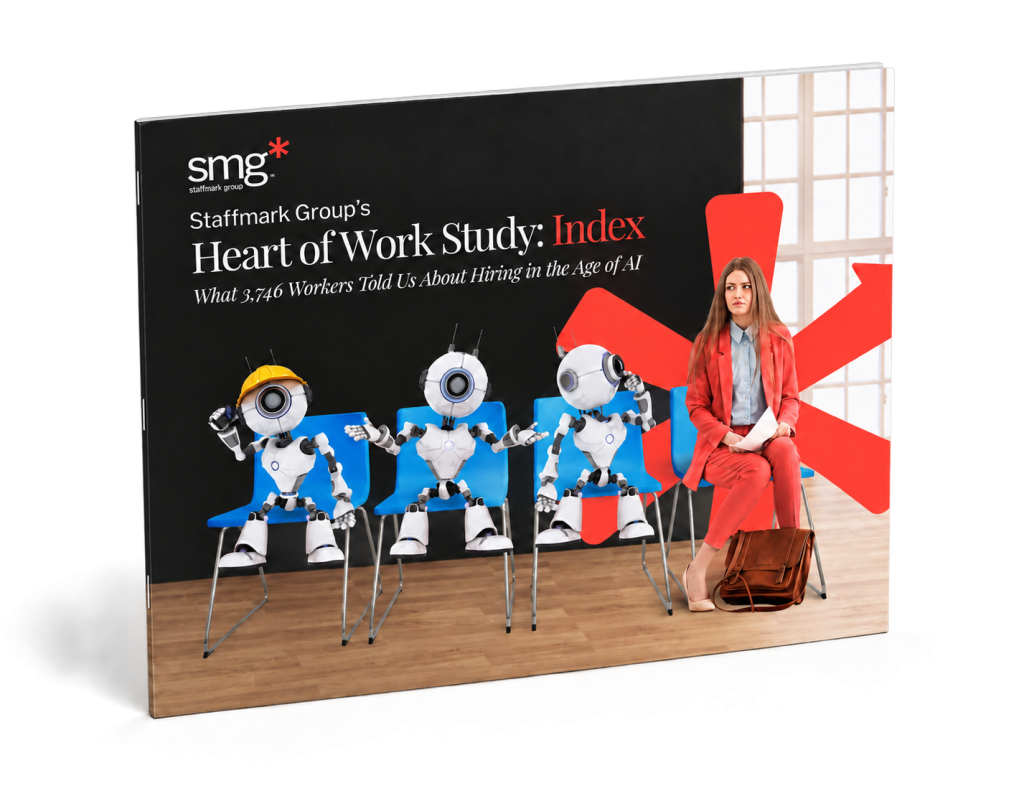
Staffmark Group’s Heart of Work Study reveals a surprising disconnect between job satisfaction and job loyalty, and the workforce risks that could be hiding in plain sight.
Turnover Is Costing You More Than You Think.
Every departure comes with a price. Recruiting replacements, onboarding new employees, lost productivity, and unfilled shifts can add up quickly, often creating costs that extend well beyond the expense of replacing a worker.

Recruiting

Onboarding

Lost productivity

Unfilled shifts
Employee turnover affects more than your headcount. It impacts productivity, performance and your bottom line.
Cost of Turnover Calculator
What is turnover really costing you?
Pick your workforce and industry. We'll fill in the national averages, and you can swap in your own numbers anytime.
Adjust the averages
Your estimated annual cost of turnover
$122,486
Each person who walks out the door costs you about $5,104 .
What if more of your people walk?
57% of workers say they'll look for a new job in the next six months. (Source: 2026 Heart of Work Study) Slide right to see what it costs if more people leave, or left to see what you save if fewer do.
Want to know how your current pay rate and hiring practices may be impacting your turnover?
Get your customized wage report →How we calculate it: cost of each exit = cost to hire + paid training time (weeks × weekly pay) + lost output while a new hire gets up to speed (weeks to full speed × weekly pay × 50%). Annual cost = cost of each exit × people leaving each year. Hourly pay assumes a 40-hour week. Sources: turnover rates are 2025 BLS JOLTS annual quit rates by industry for employees hired directly by employers, not temporary or staffing agency workforces, which typically see higher turnover (voluntary quits only, so layoffs aren't counted); default pay is BLS average hourly earnings by industry (August 2026): production and nonsupervisory workers for hourly, all employees annualized at 2,080 hours for salaried (government uses the all-industry average); cost to hire is the SHRM 2025 Recruiting Benchmarking average for non-executive roles ($1,200); training time (1 week hourly, 2 weeks salaried) and time to full speed (4 weeks hourly, 12 weeks salaried) are estimates. Results are planning estimates and leave out harder-to-measure costs like burnout, quality issues, and lost customers, so your real number is likely higher.
Keep the Talent You Have. Win the Talent You Need.
Employees don’t necessarily need to dislike their jobs to consider leaving. Several factors can turn passive interest into active job searching.

Competitive pay changes the equation.
When wages fall behind the local market, even satisfied employees may be tempted by better offers.
Flexibility is becoming a differentiator.
More shift options, streamlined hiring, and faster decisions can make competing opportunities more attractive.
Revisiting hiring criteria
Review whether each criterion, including drug screening and stringent background checks, is truly relevant to the position.
Is pay retention a red flag for your business?
Get Ahead of the Exit
Staffmark Group helps employers anticipate workforce challenges before they become costly disruptions. We combine labor-market intelligence, competitive pay insights, flexible workforce strategies, and dedicated recruiting expertise to help clients attract the talent they need and retain the people they have.
There’s More to the Heart of Work.
The Retention Paradox is just one of the surprising findings from Staffmark Group’s Heart of Work Study.
Discover what workers really want from today’s hiring experience, how they feel about AI and automation, and why human connection still matters in an increasingly digital world.
Explore the complete research for actionable insights to help you attract, engage, and retain talent in a changing labor market.
Fill out the form below to access the full Heart of Work Report.