Workforce Optics
Insights, numbers & knowledge
for a competitive workforce
OCTOBER 2026 ISSUE
Welcome! The labor market is sending mixed signals. Job growth slowed sharply in September, yet job postings and employer hiring intentions are beginning to improve. Workers remain hesitant to make a move, even as longer-term demographic trends point toward potential talent shortages ahead. This month, Workforce Optics looks at what these contradictions mean for employers, from the growing skilled-trades gap and questions about entry-level readiness to ghost jobs, AI and the latest manufacturing trends.
Jobs Update
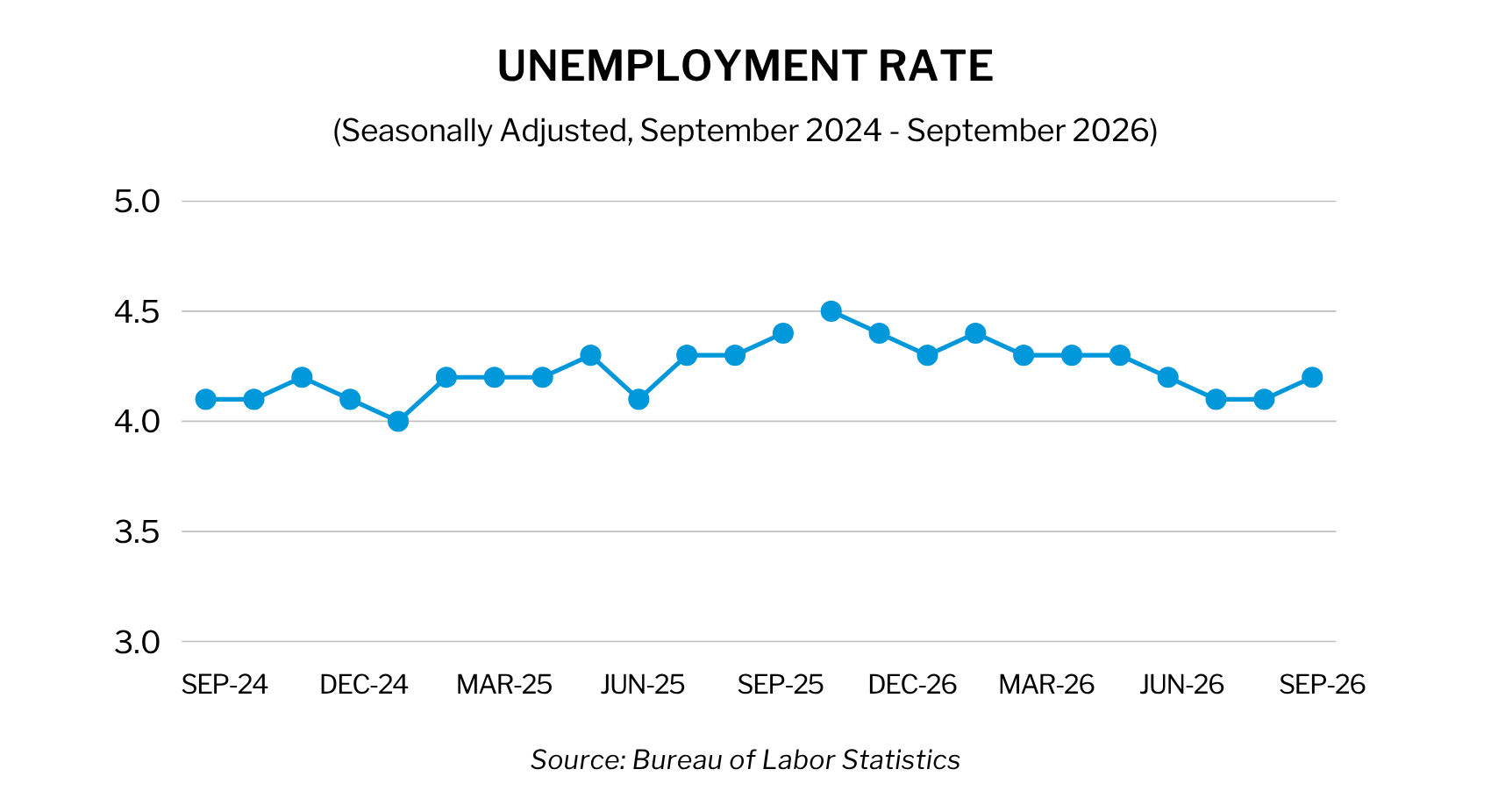
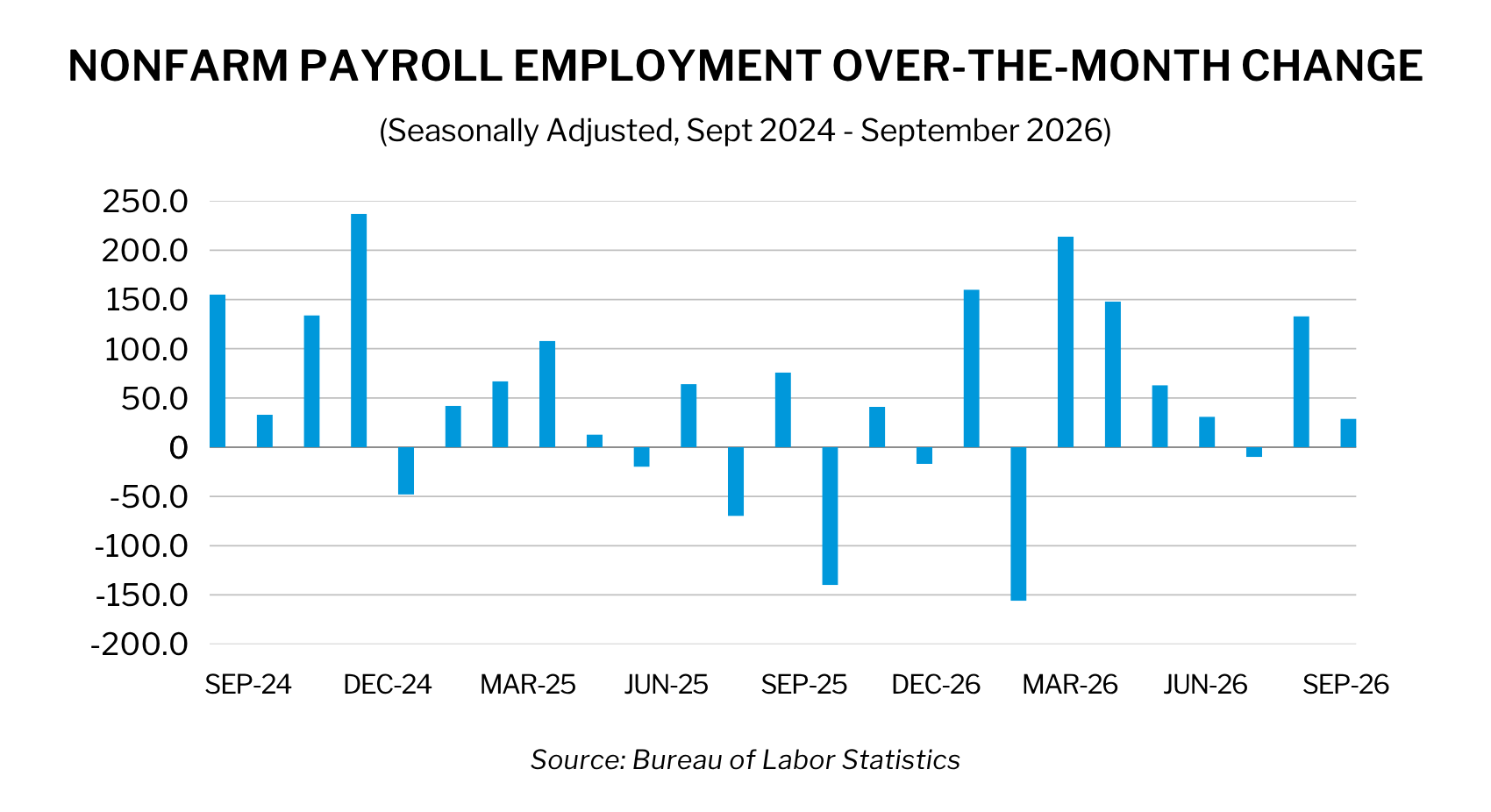
The labor market lost momentum in September, with employers adding just 29,000 jobs, well below August’s revised gain of 133,000 and the average monthly increase of 45,000 over the past year. The unemployment rate edged up from 4.1% to 4.2%, with 7.1 million people unemployed, although it has remained within a relatively narrow 4.1% to 4.3% range since March. Labor force participation ticked up to 61.8%, while the employment-population ratio remained relatively stable at 59.2%.
Hiring was muted across nearly every major industry. Healthcare continued to add jobs, gaining 17,000, although at roughly half its average monthly pace over the previous year. Construction added 11,000 jobs and manufacturing 9,000, but BLS characterized employment in both sectors as little changed. Manufacturing has nevertheless added 72,000 jobs since its recent low in December 2025.
Revisions also point to a softer labor market than previously reported. July payroll growth was revised from a gain of 21,000 to a loss of 10,000, while August was revised down by 29,000 to 133,000 – reducing combined employment for those two months by 60,000. Wage growth also moderated, with average hourly earnings rising just 0.1% in September and 3.0% over the past year. Taken together, the latest data reinforce a labor market characterized less by widespread layoffs than by subdued hiring, limited job creation and employers remaining highly selective about adding headcount.
Source: Bureau of Labor Statistics September Employment Situation Report
Job Postings Are Rising. Worker Confidence Isn’t.
The labor market may finally be showing early signs of improvement, but workers aren’t feeling the shift yet. Indeed economist Svenja Gudell says the recent rise in job postings appears to be part of a sustained trend rather than a temporary blip, with employer hiring intentions also beginning to improve. Demand is picking up across several sectors, including technology and production and manufacturing.
But Glassdoor economist Daniel Zhao cautions that more openings have yet to translate into significantly more hiring: the hires rate edged from 3.2% in July to 3.3% in August and remains essentially flat. With time-to-hire also increasing, Gudell says job postings could be a leading indicator of stronger hiring to come.
That disconnect helps explain why employee sentiment remains so weak. Zhao says Glassdoor’s Employee Confidence Index has fallen to its lowest level since the data began in 2016. Even as openings improve, workers care about whether they can actually land a better job – and many still feel stuck.
Gudell adds another source of frustration: wage growth remains lackluster for many workers while inflation continues to pressure household budgets. Both economists see signs that conditions could improve, but Zhao cautions that the recovery would need to become considerably stronger before workers are likely to feel genuinely optimistic about the job market again.
Looking beyond the current cycle, the bigger workforce challenge may eventually shift from a shortage of jobs to a shortage of workers. Gudell points to an aging population, Baby Boomer retirements and slower population growth as structural pressures that could create significant talent shortages, particularly in industries with older workforces. AI and automation may help address some gaps, Zhao says, but their impact will vary widely by occupation—and the industries facing the greatest labor shortages are not necessarily those most exposed to AI.
For employers, the message is not to mistake today’s low turnover for long-term talent security. Zhao recommends expanding talent pools through training, upskilling and reaching underrepresented workers, while Gudell points to skills-based hiring as a way to find people capable of doing the job even if they lack the traditional title or background. As she puts it, today’s “job hugging” isn’t necessarily a happy hug – and employers should be planning now for where tomorrow’s workers will come from.
About the experts

Svenja Gudell is the Chief Economist at Indeed, where she leads economic research and analysis on global labor market trends. Her work focuses on workforce dynamics, hiring demand, and the intersection of technology and employment.

Daniel Zhao is the Chief Economist at Glassdoor, where he oversees labor market research and workplace analytics. He specializes in employee sentiment, job search behavior, and economic forces shaping the modern workplace.
employment news of note
Ghost Jobs Could Come Back to Haunt Employers
“Ghost jobs” – openings employers advertise but never fill – are drawing increasing scrutiny as frustrated job seekers navigate an already difficult hiring market. Korn Ferry reports that as many as one in five online job listings may be ghost jobs, while a 2024 survey found 40% of hiring managers said their companies had posted a fake job during the previous year. The practice has attracted lawmakers’ attention: New Jersey and Pennsylvania have proposed legislation requiring greater transparency around hiring timelines and filled positions, while a bill passed by New York lawmakers would impose fines for ghost listings if signed into law.
For employers, the issue extends beyond potential regulation to candidate trust and employer reputation. Korn Ferry warns that repeatedly advertising jobs that never appear to be filled can become a red flag for candidates, potentially alienating the very talent companies will need when hiring accelerates. Regularly auditing job postings, removing inactive roles and being more transparent about genuine hiring intentions could therefore become increasingly important parts of the candidate experience.
Source: Korn Ferry, September 1, 2026

Are New Grads Unprepared or Are Employers Expecting Too Much?
Employers are increasingly questioning whether new college graduates are ready for the workplace, but the perceived skills gap may be as much about changing employer expectations as Gen Z itself. A recent survey cited by Business Insider found that 75% of companies considered some or all of their recent graduate hires unsatisfactory, while another survey found 37% of HR leaders would prefer AI or automation to hiring a recent graduate for a role.
Employers are particularly concerned about communication, professionalism and critical thinking – skills that have become more valuable as AI takes on more technical and routine work. The emerging challenge for employers is two-sided: recruit for increasingly valuable human capabilities such as communication, judgment and critical thinking, while recognizing that early-career employees may still need training, mentoring and real-world experience to develop them.
Source: Business Insider, August 31, 2026
Three Jobs, One Worker: The Skilled Trades Talent Gap
Interest in skilled-trade careers is surging as workers look for alternatives to four-year degrees and careers potentially vulnerable to AI, but the influx isn’t keeping pace with employer demand. According to research by Lightcast, there are now three skilled-trade job openings for every trained worker, creating an estimated shortage of 1.3 million workers annually at current enrollment rates. Demand is becoming particularly important as companies invest in data centers, manufacturing facilities and other infrastructure projects, making shortages of skilled professionals a potential constraint on business growth.
But demographics could make the shortage harder to solve. More than 25% of skilled-trade workers are approaching retirement, while the sector already accounts for roughly 20 million U.S. jobs and 2.1 million openings annually. As businesses focus on preparing their workforces for AI, the bigger near-term talent challenge for some employers may be finding enough people with the hands-on skills technology still can’t easily replace.
Sources: Korn Ferry, September 1, 2026; Lightcast, August 25, 2026

Manufacturing Update
Manufacturing Growth Continues, with a Few Warning Signs
U.S. manufacturing continued to expand in September, though overall momentum was largely unchanged from the previous month. The ISM Manufacturing PMI registered 54.5%, down slightly from 54.6% in August, marking the sector’s ninth consecutive month of expansion.
New orders strengthened to 55.3%, while production remained solid at 56.7% despite slowing from August. Employment also improved, rising to 52.7%, suggesting manufacturers continued to add workers during the month.
The bigger concern is cost pressure. ISM’s Prices Index jumped 6.8 percentage points to 77.9%, while supplier deliveries continued to slow and inventories slipped back into contraction. Meanwhile, five of the six largest manufacturing industries expanded in September. Taken together, the report points to a manufacturing sector that remains on solid footing, with strengthening demand and employment offset by mounting input costs and continued supply-chain pressures.
Sources: Manufacturing ISM® Report On Business® & Institute of Supply Management, September 2026
| ISM’S EMPLOYMENT INDEX | |||||
|---|---|---|---|---|---|
| EMPLOYMENT | %HIGHER | %SAME | %LOWER | NET | INDEX |
| September 2026 | 15.3 | 70.2 | 14.5 | +0.8 | 52.7 |
| August 2026 | 11.8 | 76.7 | 11.5 | +0.3 | 51.2 |
| July 2026 | 16.3 | 70.4 | 13.3 | +3.0 | 52.8 |
| June 2026 | 16.2 | 70.0 | 13.8 | +2.4 | 49.7 |

the takeaway
Manufacturing remains firmly in growth mode, with stronger new orders and continued hiring signaling healthy demand. However, rising input costs and persistent supply-chain pressures could test that momentum in the months ahead.
About Staffmark Group
Staffmark Group (SMG) is one of the largest staffing companies in the United States and is a portfolio company of RGF Staffing and Recruit Group, renowned for pioneering brands like Indeed and Glassdoor. Harnessing our global strength and innovation, we power your business with the people, flexibility, and data insights you need to succeed in your market.
From the bustling floors of manufacturing facilities to the dynamic environments of technical and professional firms, we offer the widest range of specialized workforce solutions. The expertise of our specialty brands, Advantage Technical, Digital People, Hunter Hamilton, Employee Management Services and Staffmark, ensures the talent and customized solutions to propel your business forward.

Ready to build a workforce strategy that works?
Put the power of Staffmark’s 400+ local resources and thousands of skilled talent to work for you. Tap into a partner who listens first and customizes the right solution.
Ready to build a workforce strategy that works?
Put the power of Staffmark’s 400+ local resources and thousands of skilled talent to work for you. Tap into a partner who listens first and customizes the right solution.


